Pi Durable: A Look at the Future of Agent Harnesses
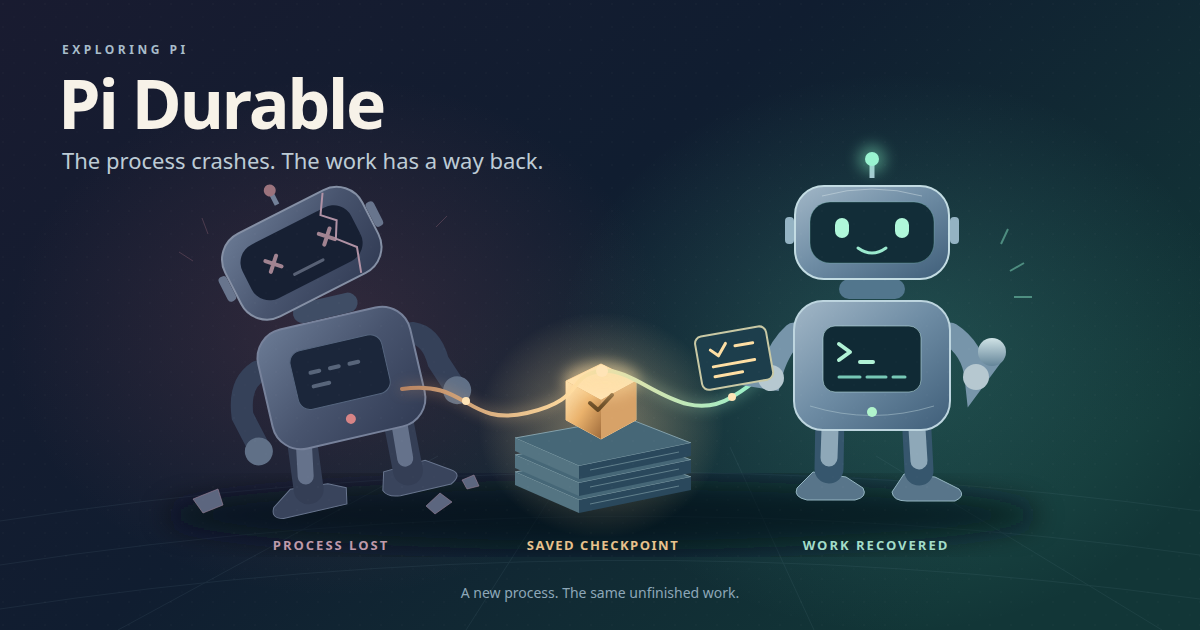
Pi Durable's building blocks: persisted tasks, conversations, application state, and agents whose work can survive the process that started it.
- 1. Managing Context Windows with pi /tree: Branches, Summaries, and Subagent-like Workflows
- 2. Pi Durable: A Look at the Future of Agent Harnesses
Pi Durable was released alongside Pi 1.0 on October 1. I was excited to try it out and spent some time experimenting with tasks, persisted state, and recovery.
Pi Durable is a durable agent harness: a framework that runs the model/tool loop and stores conversations, application state, and unfinished work. Here, the harness is the runtime around the model—calling it, executing its tool requests, and managing how the work continues. Pi Durable adds persisted tasks and recovery rules so that execution can continue after a process restart.
What interested me was not just saving a chat. Pi already saves sessions. It was saving enough of the work that a new process can continue it without treating the conversation as its only clue.
This post is about how those pieces fit together: conversations, tasks, application state, and the rules for recovering when execution stops halfway through.
Why another harness?
An interactive coding session has a fairly natural lifetime. I start the agent, work with it, and return to the session history when needed. In my Pi /tree article, I explored how branching and summaries make that history useful without putting every detour into the model’s context.
But consider a long-lived agent that handles requests in a team’s Slack channel. It serves several people, works in independent threads, and runs background tasks while other conversations continue. Its work needs to survive process crashes, restarts, and deployments.
At that point, reopening the conversation is only part of the problem. Which tasks were still running? What were they waiting for? Was a follow-up admitted? Did an external request finish?
An extension can implement its own answers to those questions. Pi Durable brings shared machinery for them into the harness.
It builds on pi-ai for model access and provides a foundation for new agent applications, rather than replacing the Pi coding agent.
Recovering context and execution
A transcript records user messages, model responses, tool calls, and tool results. That is useful execution evidence, not just chat text. But it does not, by itself, supply the scheduler or recovery rules for unfinished work.
Pi Durable stores task records and documents alongside that history. Tasks record progress and ownership. Documents hold application state, including queued inputs and live generation or tool output.
The conversation tells us what was said and recorded. The execution state tells the runtime what work remains and where to continue.
flowchart TB
  subgraph Stored["1 · Saved together in persistent storage"]
    History["Transcript entries<br/>Messages, calls, recorded results"]
    Tasks["Task records<br/>Checkpoints, owners, waits"]
    Docs["Documents and submissions<br/>App state, live progress, queued inputs"]
  end
  History --> Open
  Tasks --> Open
  Docs --> Open
  Open["2 · A new host installs the definitions<br/>and opens the same storage"]
  Open --> Scheduler["3 · Resume scheduling<br/>Previously running tasks become pending on open"]
  Scheduler --> Phase["Continue unfinished task phases<br/>from their saved checkpoints"]
  Scheduler --> Completed["Completed tasks stay completed<br/>Their results remain available"]
  Phase --> Policy{"Interrupted tool effect?"}
  Policy -->|Replay-safe| Retry["Rerun the call"]
  Policy -->|Not replay-safe| Interrupted["Commit an interrupted result<br/>Preserve saved output"]

  classDef stored fill:#eaf3ff,stroke:#3978b5,color:#172b40;
  classDef runtime fill:#f1eef9,stroke:#8470ac,color:#302347;
  classDef recovered fill:#ebf7ef,stroke:#43845c,color:#173723;
  classDef caution fill:#fff3e6,stroke:#b77d38,color:#644015;
  class History,Tasks,Docs stored;
  class Open,Scheduler,Policy runtime;
  class Phase,Completed,Retry recovered;
  class Interrupted caution;
The diagram is a recovery map, not a promise to rerun everything. Custom tasks follow the recovery code in their phases. Built-in model and tool tasks have their own policies. A checkpoint is saved data for those rules—not a suspended JavaScript stack.
Suppose an agent finishes an issue-tracker search and starts a deployment. The process dies during deployment. Recovery can retain the completed search and identify the interrupted deployment call. It does not have to ask the model to reconstruct the entire workflow from the transcript.
Whether the deployment actually happened is a separate question. We will come back to that boundary.
The commit is the important unit
The part I find most useful is that these records are not saved independently.
A commit can append transcript entries, change task records, and update typed JSON documents together. Either the group is stored or none of it is. The harness publishes the change only after storage accepts it.
For example, a custom task could complete a review, append its findings, and mark the review complete in a plan document in one commit:
flowchart TB
  subgraph Changes["One review-completion commit"]
    Entry["Transcript entry<br/>Review findings"]
    Task["Task record<br/>Completed outcome"]
    Plan["Plan document<br/>Review marked complete"]
  end
  Entry --> Store
  Task --> Store
  Plan --> Store
  Store["Storage accepts the whole commit<br/>or rejects it without adopting the changes"]
  Store -->|Accepted| View["Publish committed state<br/>to clients and the scheduler"]

  classDef records fill:#eaf3ff,stroke:#3978b5,color:#172b40;
  classDef boundary fill:#f1eef9,stroke:#8470ac,color:#302347;
  classDef visible fill:#ebf7ef,stroke:#43845c,color:#173723;
  class Entry,Task,Plan records;
  class Store boundary;
  class View visible;
That avoids a plan saying “review complete” while the task still looks unfinished, or a visible completion message with no saved findings behind it. The application still has to put related changes in the same commit; the framework provides the boundary.
Streaming follows the same principle. Partial model answers and running tool output become visible through committed progress. The default progress intervals are 100 ms, configurable by the host. A crash retains the last successfully committed portion; output generated after that may be lost. The interval is a pacing setting, not a hard bound under slow storage.
Visible state is committed state. That gives a reconnecting client something reliable to attach to.
The building blocks
With that commit boundary in mind, the names become easier to place.
| Concept | Responsibility |
|---|---|
| Harness | Opens storage and runs the conversation and task machinery |
| Conversation | A transcript with its own agent configuration |
| Entry | An immutable transcript record: message, result, reset, or custom kind |
| Submission | An admitted input or write that can be waited on |
| Document | Typed JSON state changed through commits |
| Task | A state machine with persisted progress, ownership, and an outcome |
| Registry | The extension and task code installed in this process |
The agent is the configuration a conversation runs with: model, thinking level, instructions, selected extensions, tools, and working directory. Different conversations can run with different choices.
An extension bundles tools, prompt sections, hooks, wrappers, or tasks. Hooks can adjust a model request or block a tool call; extensions need not introduce another agent.
The split between saved state and installed code matters. Conversations save extension names, not implementation copies. After a restart, the host must install the definitions required by pending work.
Storage also has different meanings. MemoryStorage is useful for tests but disappears with the process. SQLite and JSONL persist records for reopening. The harness maintains an in-memory working set over storage; persistence is not the same thing as putting the entire history into every model request.
Compaction summarizes older context while retaining history in storage. A reset starts a new active context, optionally with a handoff note. These change what the model sees, not whether the past exists.
How the model loop uses tasks
Pi Durable can own the model/tool loop itself. An input is admitted as a submission, a generation task asks the model, and tool calls become child tasks. Once their results are committed, the run can proceed to another generation.
admit input
  → generation task
    → model response with tool calls
      → tool tasks and committed results
    → next generation
      → final answer and settled submission
A turn is one model response and its tool calls. A run goes from an input to its final answer, possibly through several turns. Generation and compaction use the same task machinery as tools and custom work.
File and process access comes through an execution environment. The host can supply local access or a custom environment, such as a container per conversation. Changing a conversation’s working directory is not, on its own, a sandbox or permission boundary.
Custom tasks can also coordinate another agent runtime. That is application integration work: saving a coordinator’s checkpoint does not automatically make the external runtime’s execution recoverable.
Recovery is a policy, not blind replay
For work that touches an external system, the useful pattern is:
commit intent → perform the effect → commit the outcomeThe intent records what the task is about to attempt. The outcome records what it learned. The external action happens between them, outside the storage transaction.
That leaves an unavoidable crash window:
sequenceDiagram
  participant T as Durable task
  participant S as Storage
  participant E as Deployment service
  T->>S: Commit intent and stable request key
  T->>E: Request deployment with that key
  E-->>T: Accepted
  Note over T: Process dies before outcome commit
  Note over S: Intent exists, outcome is missing
  Note over E: Deployment may already be running
The same saved checkpoint could mean the process died before sending the request or after the service accepted it. Storage cannot distinguish those cases by itself.
The task therefore needs a recovery strategy:
- Retry safely: use an idempotency key the external service honours. Save or deterministically derive the key before the effect, so recovery uses the same one.
- Query the operation: retain a remote handle and ask for its status, where the service supports that.
- Record interruption: report uncertainty instead of silently repeating the action; let application policy or a person reconcile it.
Built-in tool calls follow this distinction. A tool declared replay: "safe" can rerun after interruption. Otherwise, the model receives an interrupted error result with the output committed so far. That label is a contract the tool author must justify.
Interrupted streamed model requests can be retried, with saved partial answers retained as aborted entries. Deferred requests with a saved provider handle can instead continue by polling. Recovery does not always mean a fresh request.
A memo is a named value saved on a task, so the task can reuse it after a restart. For each name, the first committed value wins: later attempts to save a different value return the one already stored.
For example, a tool might ask for approval and save the answer as an approval memo. If execution restarts after that save, the tool can read the same answer instead of asking again or making a new decision. The checkpoint identifies the next phase; the memo preserves a value that phase needs. A document, by contrast, holds application state such as a shared plan.
Saving approval does not prove that the approved action ran. If a deployment was interrupted, its outcome still needs the recovery strategy described above. Similarly, a submission’s requestId prevents duplicate admission of an input—not every effect that input might cause.
Pi Durable makes uncertainty explicit and gives recovery a place to live. It does not guarantee exactly-once external effects.
Subagents have ownership and a lifetime
A native subagent can be a conversation owned by the tool task that created it. It has its own agent configuration and uses the same persistence machinery as the parent.
flowchart TB
  Main[Main conversation] -->|owns| Generation[Generation task]
  Generation -->|owns| Delegate[Delegation tool task]
  Delegate -->|owns| Child[Child conversation]
  Child -->|owns| Work[Child generation and tool tasks]
  Work -.->|answer through delegation tool| Main
The application writes the delegation tool. A replay-safe implementation finds the existing child and uses a stable requestId for its input rather than spawning and messaging a new child after every restart.
Ownership gives cancellation structure. Aborting foreground work reaches what it owns, with cleanup proceeding bottom-up. A task finishing successfully waits for its owned work to settle before becoming terminal. This draws on structured concurrency: child work belongs to an explicit lifetime.
Background tasks introduce a deliberate boundary. They do not keep the parent’s current run busy and can survive its ordinary abort. The official examples use background owner tasks and reporter tasks to support persistent subagents whose answers arrive later as follow-ups.
That makes “research this while I keep chatting” more than a second model call. It has an owner, a durable identity, and a return path.
Forking is a different operation: start another conversation from a point in an existing transcript. Document policies choose fresh, current, or historical state for the fork. As with Pi’s /tree, conversation branching does not roll back files or create isolated Git checkouts.
One conversation, several interfaces
The browser does not have to own the work’s lifetime.
Pi Durable exposes a committed conversation view. A client attaches to the current state, then watches updates. A late-joining client starts from that view rather than needing every event since the conversation began. A host can expose this to a terminal, web UI, or phone.
Inputs can also be queued while work is busy. Follow-ups start later runs; steering joins ongoing work at tool-round boundaries. “Check the staging logs first” can become input to the current run rather than a new unrelated session.
There is another useful distinction here: cancelling a wait does not cancel the work. Closing a client or abandoning its wait is different from explicitly aborting a submission or conversation.
For a mobile interface, that is appealing. I can leave the page, return later, and see persisted work rather than depending on a tab that stayed connected. The host still needs authentication, authorization, and a policy for several people steering the same conversation.
Durable does not mean frozen
Persistence also creates room for malleability: changing the available capabilities without throwing away the work.
Installing an extension under an existing name replaces its registry definition. A running tool call keeps the implementation it started with; subsequent phases or calls can use the replacement. After restart, saved work resolves against the definitions the new process installs.
That is useful for improving a tool or changing an agent’s workflow during a long-lived conversation. But saved checkpoints and new code must remain compatible. Reload is not an automatic migration system, and generated changes still need tests and an explicit activation step.
What the host still has to do
Durable does not mean always running, and it does not mean indestructible storage.
| Boundary | Host responsibility |
|---|---|
| Process crashes | Supervise, restart, reopen storage, and resume scheduling |
| Storage ownership | Enforce one process per storage; the harness supplies no cross-process ownership lock |
| External effects | Provide safe retries, status checks, compensation, or reconciliation |
| Users and tool access | Supply authentication, authorization, and execution isolation |
| Storage loss and upgrades | Back up data and test version/checkpoint compatibility |
The SQLite adapter uses WAL with synchronous = NORMAL: it survives process crashes, but the newest commits may be lost on power or host failure. JSONL has its own flushing choices. Those details matter when deciding what “durable” means for a deployment.
What this changes
In my state-machine article, I argued that code should own continuity and authority while a model supplies judgment at the branches.
Pi Durable provides machinery for that continuity, while also supplying a model/tool loop. The important separation is:
model            = reasoning and tool selection
Pi Durable       = committed state, owned tasks, and recovery machinery
application code = capabilities, policy, and external integration
interface        = a view of the work, not its lifetime
The result is a foundation for long-running conversations, background subagents, and interfaces that can come and go without taking the work with them.
What I want from an agent application is not just an answer. It is a clear account of what finished, what is still pending, and what is safe to do next—even after the process that started it has gone away.
Pi Durable is experimental, but that is a direction worth exploring.
Sources and version scope
My experiments used @earendil-works/pi-durable, pi-ai, and chord at 1.0.2. The repository links track current code. This post explains the concepts rather than presenting a tested API tutorial. The API is experimental, so check the documentation and recovery behavior for the version you deploy.